
Powder Coating vs Liquid Painting: Why Powder Wins
Powder coating beats liquid paint on durability, VOC compliance & cost in India. See the full comparison from OptiFinish — authorised GEMA & Dürr partner, Greater Noida.
Powder coating has largely displaced traditional liquid painting in industrial finishing applications across India. The shift is not a trend — it is driven by measurable advantages in durability, environmental compliance, operational efficiency, and total cost. At Value Added Coating Solutions Pvt. Ltd. (VACSPL / OptiFinish), we have built and commissioned powder coating plants across India and seen this transition accelerate in sector after sector.
This article provides a clear, factual comparison of powder coating vs liquid painting — the key considerations for manufacturers evaluating their finishing process.
What Is Powder Coating?
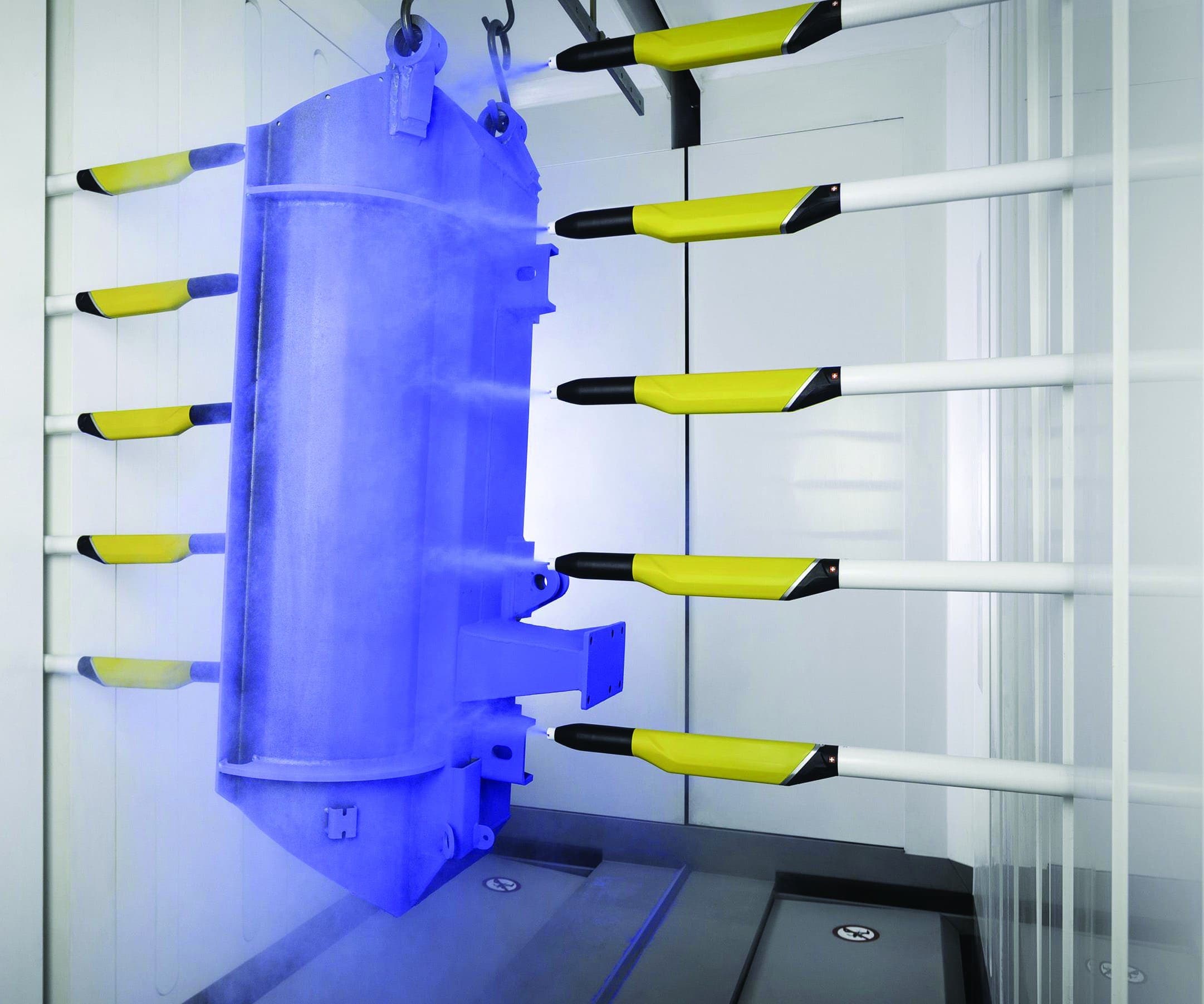
Powder coating is a dry finishing process where finely ground particles of pigment and resin are electrostatically applied to a grounded metal surface, then cured in an oven at 160–200°C. The result is a hard, continuous film without drips, runs, or solvent emissions.
What Is Liquid Painting?
Liquid painting (wet paint) involves applying a liquid formulation — dissolved or dispersed resin, pigment, and solvent — to a surface. The solvent evaporates (or the material crosslinks with a hardener) to form the final film. Conventional liquid paints include alkyd enamels, epoxy paints, polyurethane paints, and 2K systems.
Head-to-Head Comparison
Durability
Powder coating produces a chemically crosslinked thermoset film that is harder, more scratch-resistant, and more resistant to impact than most liquid paint systems. Powder-coated parts in Indian outdoor environments — fencing, agricultural equipment, outdoor furniture — routinely achieve long service life with minimal maintenance. By comparison, liquid paint typically produces a softer, more flexible film. Premium 2K liquid systems can approach powder in performance, but most standard liquid paints used in Indian industry offer lower resistance to abrasion, UV, and chemical exposure. For the majority of industrial metal finishing applications, powder coating is the more durable choice.
Environmental Compliance
Powder coating contains no solvents, meaning there are effectively zero VOC (Volatile Organic Compound) emissions during application. This makes powder coating plants significantly easier to comply with Indian CPCB and state pollution control board regulations, and overspray is captured and reused rather than discharged. Liquid painting, on the other hand, involves solvent emissions during both application and drying. Solvent-borne liquid paints are increasingly subject to regulatory restriction in India, requiring costly emission control equipment or reformulation to water-borne alternatives — adding complexity and cost to liquid paint operations.
Material Efficiency
On conveyorised automatic lines, powder coating achieves high transfer efficiency, and overspray is recovered and reused in a closed loop. Powder does not drip, drain, or evaporate between the gun and the part. Liquid painting, by contrast, involves solvent loss through evaporation, drips and runs that create waste, and booth sludge that must be handled and disposed of as hazardous waste — all of which add to material cost and waste management burden.
Finish Quality and Consistency
Powder coating produces a consistent, uniform film thickness without runs or drips, and colour consistency across large production batches is reliably maintained. A wide range of textures — smooth, matt, satin, gloss, textured, and metallic — is available in powder form from Indian and international powder suppliers. Liquid painting requires skilled operators to maintain consistent film thickness and avoid sagging, and multi-coat systems (primer plus topcoat) add complexity and drying time. For most industrial applications, powder coating delivers better batch-to-batch consistency with less operator dependency.
Operational Simplicity
Powder coating does not require solvent storage or handling, has no pot life limitations (powder can be reused from one day to the next), and produces no hazardous liquid waste from the booth. Plant operation is straightforwardly safer. Liquid painting requires controlled solvent storage with appropriate fire safety measures, careful waste disposal of sludge and solvent-contaminated materials, and more detailed safety protocols — all of which add to the operational overhead of running a finishing line.
Where Liquid Paint Retains an Edge
Powder coating is not the right choice for every application:
- Temperature-sensitive substrates — plastics, wood composites, and electronics that cannot withstand oven curing temperatures
- Very large structures that cannot be moved into a spray booth or oven
- Touch-up of installed products in the field — powder coating cannot be field-applied
- Complex 2K colour-matching for decorative applications requiring infinite colour mixing
For these applications, liquid paint systems remain the preferred choice. OptiFinish is an authorised Dürr partner in India and can supply and commission Dürr liquid coating equipment for applications where liquid coating is the technically correct solution.
The Verdict for Indian Manufacturers
For the vast majority of metal finishing applications in India — automotive components, steel furniture, agricultural equipment, electrical enclosures, architectural sections, general fabrication — powder coating delivers superior performance, lower environmental impact, and better long-term economics than liquid painting.
OptiFinish designs and builds complete powder coating plants in India. Our team in Greater Noida handles requirement analysis, plant design, equipment supply, installation, and commissioning.
Contact OptiFinish to assess whether powder coating is right for your specific application and to discuss plant design options.